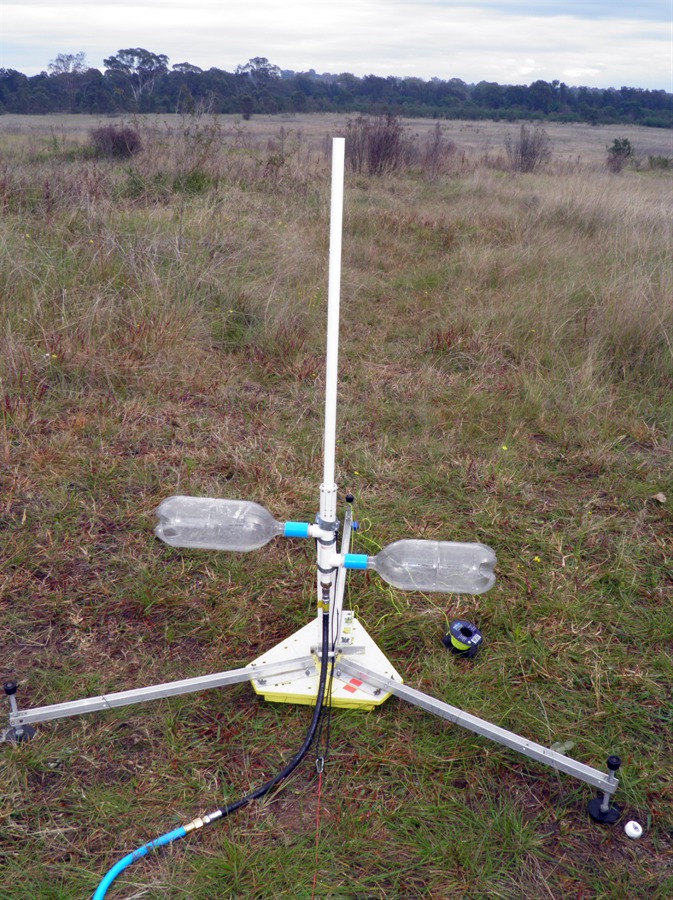
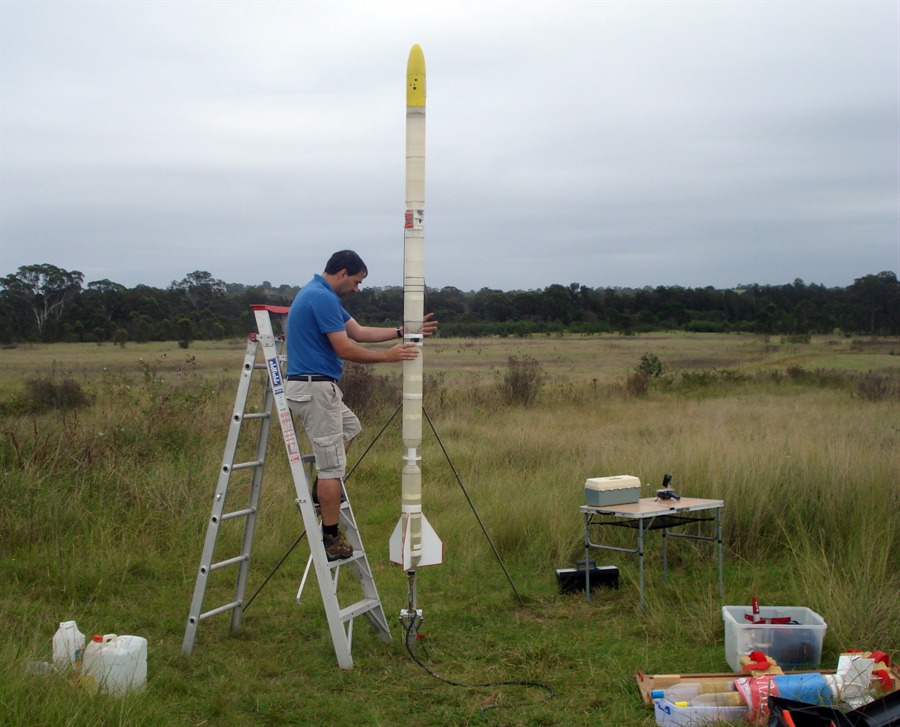
This blog covers the day to day progress of water rocket development by the Air Command Water Rockets team. It is also a facility for people to provide feedback and ask questions.

Sunday, July 01, 2012

Shadow II flies to 1,239 feet (377m)

We had a fun launch this weekend at the NSWRA launch at Doonside. The weather was almost perfect for rockets with calm conditions and blue skies. We took the repaired Shadow II for a spin on two flights. The first flight was at 400psi and reached an altitude of 1173 feet (357m). We then set it up again for a second launch at 420psi. This time the rocket reached 1239 feet (377m). Both of these altitudes were our new personal best. We are happy the rocket survived both flights and it also took some nice video in the process.

I have uploaded the full flight report to here:
http://www.AirCommandRockets.com/day121.htm

The report includes pictures and a highlights video from both launches.

 Chris launching the rocket. This was the second launch of the day.

Apogee photo from flight #2

Monday, June 18, 2012

ARB Test flights

Last week we did an experiment to compare how a launcher fitted with Air Reservoir Boosters (ARBs) performs vs. one without them. We had to build a new launcher for this experiment so that we could fit the ARBs to a full bore launch tube. The launcher is based on the Clark cable-tie release mechanism. We also worked on an improved splice that is lighter and has more volume than the ones we have been using. We still use the Asymetric #5 technique, but with a narrower sleeve and less overlap. We did 9 test flights for the experiment plus one more for the new splice. Thankfully they all came back safely and no repairs are needed.

The full write up of the experiment and splice info is here:

http://www.AirCommandRockets.com/day120.htm


New Launcher fitted with two 2L ARBs.

Monday, June 04, 2012

6 Years

Today it's been 6 years since our very first horizontal launch in the back yard. Water rocketry certainly continues to be a very rewarding engineering challenge and has allowed us to meet many new like-minded individuals from both the water rocketry world as well as the dark (pyro) side of the universe. It's been fascinating to watch how the hobby has developed over the years and how many new individuals and teams have helped to perpetuate the water cycle in the lower troposphere.


Very first Launch 4th June 2006


Here are some statistics about the last 6 years of operations:

Total Number of rockets launched or statically tested: 639

of these there were:
- 494 single stage water rocket flights.
- 47 multi-stage / boosted water rocket flights.
- 34 single and multistage pyro rocket flights.
- 64 static firings in tests and experiments (we don't count burst or pressure tests)

- 685 separate stages flown (pyro and water) and of these there were 74 crashes or CATOs. This gives an average failure rate of ~10.8% (In other words about 1 crash in 11 launches.)
- Only 1 lost rocket that is still stuck in a tree. (We may still get it back.)

- The highest launch pressure to date has been: 360psi (~25 bar)
- The highest water rocket altitude achieved: 1017 feet (310 m)
- The highest pyro altitude achieved: ~2500feet (760 m)
- total volume of water used: ~812L (217 gallons) = ~5 bath tubs full of water.

Other fun facts:
- We have never flown a full bore nozzle on a bottle. (19mm is the largest nozzle to date)
- We have never flown a Tomy timer deployment mechanism.
- We have never built or used a Clark cable tie launcher.
- We have never used a bicycle pump to pressurise a rocket. (we have used a car tyre inflator though)

We now have so many unfinished projects that we need to go back and start ticking some of them off. The status on some of the projects we currently have under way include:

Shadow II - We are slowly making progress on this front. We hope to have this rocket fly again soon.

Polaron G2 Phase 2- The progress on this has stalled for the time being. Currently the main technical challenge is holding down the entire rocket. The neck by which the rocket is going to be held down needs some serious reinforcing. We need to work out how to do this. The alternative is to hold down each of the boosters individually but this will be a lot more work. Attaching the pins and tubes to the rocket and boosters will also be a challenge for the higher pressures.

Acceleron V with a high pressure sustainer. This has been on hold for quite a while. We need to do a range of tests at the higher pressures on the whole staging mechanism. We are targeting pressures of around 220-250psi for the sustainer while keeping the boosters at the lower 120psi. Currently this is low priority.

Software - I've been working on a software application for the past year that is mostly aimed at pyro rockets, but is also very applicable for water rockets. About two months ago I started a complete re-write to make it much more versatile and the application is currently in Alpha. I will be posting a lot more on this in the coming months when it is released. This is also the main reason we haven't been doing too many updates lately. :)

More experiments - We have a long list of experiments we would like to fly. If the weather holds up we intend to fly one this weekend.

We would like to thank everyone for their great support over the last 6 years. We're looking forward to the next 6.

- The Air Command team.

Friday, April 13, 2012

Polaron G2 Flight Report

I've finished with this week's flight report and put it on our main website as usual here:
http://www.aircommandrockets.com/day118.htm
The report includes a highlights video of the Polaron G2 flight as well as photos. The heavily overcast conditions meant that a lot of the colour in both video and photos was a little washed out.

The rocket flew well, but lower than what simulations predicted. We were happy that both the main and the backup parachutes opened when they were supposed to. :)

Tuesday, April 10, 2012

Polaron G2 flight

We had a very good flight weekend this week. We took the full length Polaron G2 for another flight. The flight went really well, as did a number of other smaller launches. It's always good to come away from a launch without needing to do any repairs. I'm putting together an update from this weekend and should have that ready towards the later part of the week. I've also posted an update from previous weekend's launch here:
 http://www.aircommandrockets.com/day117.htm though it was mostly just a casual launch day.

Here is a picture of the boys recovering the G2 rocket from the tall grass:

Wednesday, February 15, 2012

Shadow flies to 947 and 1017 feet

I’ve updated our main website with the launch report from this Sunday. The Shadow had a perfect first flight at 330psi. It reached 947 feet, deployed it’s parachute at apogee and gently landed in the grass. On the second flight at 360psi the parachute failed to deploy, and the rocket crashed heavily. Although the camera was destroyed, the altimeter still recorded the flight. The altimeter read out 1017 feet.

The update includes photos, video and the altimeter data as well as additional performance info. It also discusses what we suspect went wrong with the deployment mechanism. 

http://www.AirCommandRockets.com/day115.htm

The rocket is not a total loss though, and most of it can be reused or repaired. In fact repairs have already begun to see if we can get the Shadow to at least repeat the last flight without damage. :)


Sunday, February 12, 2012

Shadow Flights

We had a good day at the club launch today. :) The conditions were ideal with very little wind and blue skies. It was a relief to get such good conditions for the first test flights especially after the weeks of rain. Here are a couple of photos from today:


2nd Flight @ 360psi (Photo: Chris Barnes)

Apogee photo from flight 1

We will put together a launch report again over the next few days.

Friday, January 27, 2012

Launch postponed

The NSWRA launch has been cancelled for this weekend due to the continued slightly damp conditions. This means we need to postpone the launch of the Shadow again until the next launch window opportunity. NSWRA is having a "show-and-tell" day instead which should be fun since we normally don't get a chance to talk to people at length during a regular launch day.

The extra time should give us an opportunity to do a little more testing before the launch.

Monday, January 23, 2012

Progress update

It's been mostly quiet on the rocket development side over the last few weeks with the school holidays, and being busy at work. But progress has been continuing on the Shadow. I've mostly been working on the payload bay that carries the batteries, altimeter and camera. That's now mostly complete and just needs to be secured in the rocket. I still need to drill access holes for all the electronics.

Dad and I discussed an issue yesterday about how the uMAD behaves. Due to the magnetic inclination in Sydney being about -64 degrees the uMAD detects apogee differently in different directions as you would expect. While in the "good" directions it detects apogee just as the rocket turns below horizontal, but in the worst case scenario the rocket needs to be near vertical (inverted) to detect apogee. If the rocket were to weather cock in the "bad" direction (and Murphy says it will) and flew in an arc, it may never reach the near vertical flight path in relation to the magnetic field. So we decided to include a timer back up for parachute deployment. Since there really isn't a whole lot of room for a fully redundant system, we decided to do a firmware update for the servo timer, so that it will handle both the external uMAD input as well as it's internal timer.

We are going to use the break wire option again to trigger the timer. The servo timer firmware has now been updated so that which ever event fires first the servo will be activated. The firmware listens to the uMAD even if there is a problem with triggering the timer.

We've also been looking at the Polaron G2 - Phase 2 development. One of the things that is evident in releasing the clustered rocket from a common point is that there will be about 2000N pulling on the neck of the central bottle while on the pad. This would likely damage it, and so we are re-designing how the nozzle will be attached, and likely include struts to distribute the load from the boosters.

We've had several requests now for a tutorial on how we fold our parachutes, so earlier in the month we posted a how-to fold a parachute tutorial to add to the myriad of others already on the net. http://www.aircommandrockets.com/parachutes.htm

I've also spent some time this month re-editing some of the old videos, removing boring bits, improving the colour, and re-uploading them in higher resolution to the new YT channel. This process will take a while though before all the videos are processed.

The Shadow is currently scheduled for its maiden flight on the 28th January if the weather and winds are good. Initial launch pressure will be 330psi (~23 bar) and if the rocket survives we will try again at a higher pressure.

Monday, December 26, 2011

The Shadow - Launcher video

With Christmas celebrations mostly over, dad and I put together a short video today that describes how the Shadow's launcher works and how the rocket is loaded onto the launcher. I've added the video to the latest Shadow update here:

Other than that there really hasn't been much happening with all the lead up to the holidays. I've added a few links to Facebook and Google+ from our main website. These will be updated regularly with latest developments as well so if you prefer to receive updates that way or just want to chat about rockets then those should make it easier.

Here is The Shadow with a fresh coat of paint:

Thursday, December 22, 2011

Merry Christmas!!!

We all know we want one of these for Christmas


We wish you and your family all the best for Christmas and also into the new year!

Unfortunately we've run out of time to launch The Shadow this year, but we should get a chance to launch it at the next NSWRA launch in January. The quiet time over Christmas should allow us to also complete a couple of other projects that we've been working on. I'll post more on those when done.

Now where is my helmet? ... I'm pretty sure I saw a rocket sled sized box under the tree.....

Tuesday, December 13, 2011

The Shadow - coming together

We've been flat out over the last couple of weeks, but have had time to work a little on the Shadow. We've now finished the launcher, and the fins are now also attached to the rocket. The nosecone and payload bay have been painted which will make them easier to find should they separate from the rocket.

In the next week or so we should have the rest of the payload bay complete with the camera, altimeter and batteries still to be mounted. The rocket at least is now starting to look like a real rocket. :)

I've update the build log with a few pictures from the last couple of weeks.
http://www.aircommandrockets.com/shadow.htm#_061211

Tuesday, December 06, 2011

Reefing Parachutes

This weekend we went down to the local park to fly a pair of smaller rockets to test a couple of techniques for reefing a parachute to stop it opening too quickly during high speed deploys. The first technique used the old reefing ring approach and for the second experiment we simply twisted the shroud lines. We managed to fit in a total of 6 flights before the wind picked up.

We’ve written up the results from the experiments here:

http://www.AirCommandRockets.com/day114.htm

The update includes a video that shows how the reefing works in flight.

 Reefing ring preventing the parachute from opening too quickly.

Tuesday, November 29, 2011

Simple break-wire trigger

We've had a number of requests now for how to add an external trigger to the Servo Timer II for the very slow launches that the built-in G-switch may have trouble detecting. I've added a tutorial on how to add a simple break-wire option to trigger the timer on launch. In most instances it should not cost anything.

http://www.aircommandrockets.com/servo_timer_V2_0.htm#_tip5

Friday, November 25, 2011

Shadow pressure test, and deployment mechanism

We have been making good progress on the Shadow. During the week we tested the deployment mechanism and made a short video of how it works.

Today we pressure tested the launcher and rocket to the full initial launch pressure. This was the first time we had the rocket and launcher up to this pressure, so we were happy when everything worked. We even tried to see how hard it will be to launch the rocket at the full pressure. This was nice and easy and shouldn't be an issue on launch day.

 
The recent updates from the last week have been posted to our main website with photos here:
 http://www.aircommandrockets.com/shadow.htm#_171111

The update also includes the deployment mechanism video.

Tuesday, November 15, 2011

Alternative Fuels

This weekend we flew with some “alternative” fuels in our water rockets. OK so technically they weren’t “water” rockets, but hey still it was a bit of fun with the kids. From a scientific point of view it was interesting to see how these fuels behaved.

Fuels Tested:
    - Bread crumbs (dry)
    - 100’s and 1000’s (dry)
    - Sugar (dry) - the other kind of “Candy” motor :)
    - 2 minute noodles (cooked and in broth)

So how did they go? … read on:

http://www.AirCommandRockets.com/day113.htm


Friday, November 11, 2011

Shadow Launcher work

We’ve had a busy week in the workshop working on the Shadow. We’ve been mostly focusing on getting the launcher complete, so we can pressure test it and the rocket. We want to test the pressure chamber before we attach the payload bay and fins, because if it bursts, it would be wasted effort. However, we can only test the pressure chamber with the launcher.

The latest set of updates with photos is available here:
http://www.aircommandrockets.com/shadow.htm#_061111


Here is a progress photo of the launcher release mechanism. This launcher is being built for 500+ psi pressures.

11/11/11

This post has no purpose other than being posted at 11:11:11 on 11/11/11 .... Happy Binary Day. :)

Tuesday, November 08, 2011

From The Web #1

As you trawl through the interwebs, you often find interesting things that are relevant to water rockets. As I collect these, I'll try to post them here.

  • Build Your Own Servo Controller
    Here is a tiny PICAXE-08M board that's very affordable and should be fairly easy to adapt to make a simple servo controller for parachute deployment.
    http://www.hvwtech.com/products_view.asp?ProductID=1056
    You could do all your configuration through it's serial port so there would be need for only minimal external components. You could also solder one of those small Assemtech G-switches directly to the board to detect launch.
  • PL Premium in Oz
    Water rocketeer Voytek Szapirko contacted us last month with the news that he was able to find PL Premium for sale at his local hardware store Bowens in Melbourne/Hallam for $6.99 a tube.Thanks for the tip Voytek! :) If you are from Victoria keep a look out at your store. We don't have the chain here in NSW, but hopefully other stores here will catch on with the need for PL.
  • Retro Water Rockets from 1959
    Apparently you need to wear a tie to launch these: http://books.google.com.au/books?id=KdwDAAAAMBAJ&lpg=PA54&pg=PA94#v=onepage&q&f=false

Saturday, November 05, 2011

Looking Up

I've uploaded the flight report from last weekend to our main website here:
http://www.AirCommandRockets.com/day112.htm
On this flight day we flew with the out-rigger boom again but this time looking up at the rocket to watch the parachute deploy mechanism in action. The update also contains photos and a highlights video from the day.